Featured

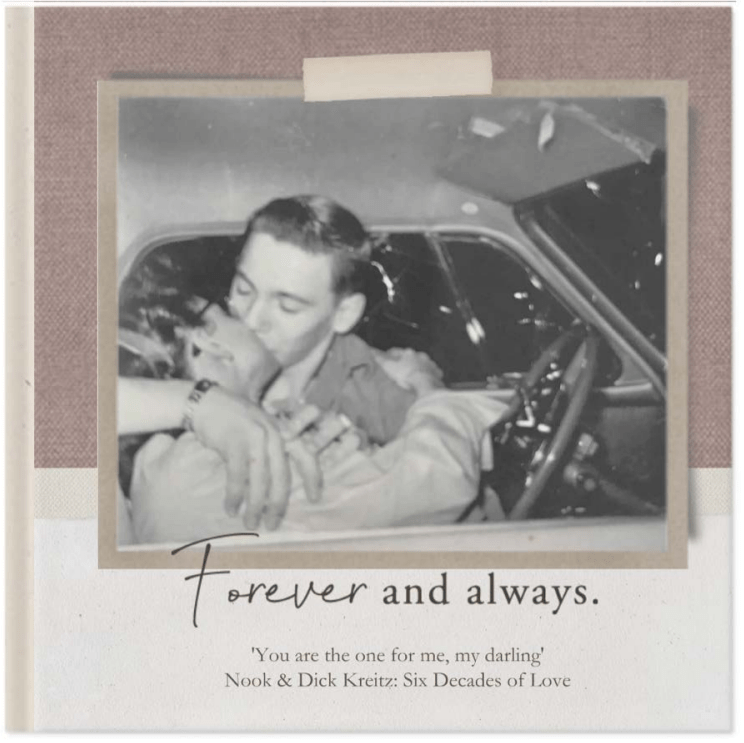
Nook and Dick Kreitz: Six Decades of Love

An excerpt of the love story of Dick and Shirley “Nook” Krietz, as told by their son and granddaughter

When Dick Krietz first spotted Shirley “Nook” Fleming at the Fairfield Shoe Factory, he said he was going to marry her.

In a letter Dick wrote to Nook while they were dating, he shared his true feelings:

“You are the one for me, my darling. My darling Shirley, I love you and hope you love me or at least like me a little. I think I have found true love with you. I intend to be your old man some day or husband as [you] could say. We’ll be happy together if we do get married, just you and me and love and babies make three. Ha ha.

“Nookie dear, marriage is a partnership for life. You have three months to decide. I love you, my darling, with all of my love.”

The couple dated no more than a year before they were married in 1954; both were 18 years old. They soon started their family with the birth of their son, Robert (Bob), in August 1955, then son Ricky in December 1956.

For the first decade of their marriage, the Krietzes didn’t have what many consider essential today. “When we were growing up, we didn’t have a car until I was probably 10,” Bob says. “We didn’t own a car, we didn’t have a phone. If we wanted to make a phone call, we had to go to my Nan’s; they had a phone in their bedroom and we’d have to talk on that there.”

Being self-sufficient was the norm for the family. “We didn’t get stuff out of a store. It was what we raised and what we shot,” explains Bob. “And they were the best times.”

♥ Ready to tell your love story? Email hello@whenwebegan.com to get started!  ♥

A Gettysburg Like No Other

This article originally appeared in Celebrate Gettysburg magazine (July/August 2019)

Photos courtesy of Molly McRoberts/Potter County News, Gettysburg, South Dakota 

Gettysburg. About an hour away from the state capital, this rural town has strong ties to the infamous battle. It epitomizes small town living with its close-knit community, where everyone seems to know everyone, and tourists make their way to the area each summer to enjoy all there is to offer.

But this Gettysburg isn’t the one made famous a century and a half ago by the events that took place those three days in July 1863.

This Gettysburg is in the middle of the South Dakota prairie.

A sign on the edge of town playfully refers to its namesake: “Gettysburg, SD—‘Where the Battle Wasn’t.’”

This town of roughly 1,300 sits in Potter County in central South Dakota. With U.S. 212 cutting through its center and the Missouri River nearby, the town sees its share of tourists and travelers, says Gettysburg, S.D., native Molly McRoberts, editor of the Potter County News, a weekly community newspaper.

In Gettysburg, South Dakota, tourists are more interested in water sports, hunting, and catching walleye, the state fish, than boning up on Civil War history. “The resorts are pretty well self-contained, but [tourists] always come to town to pick up a few things,” McRoberts says. “When it’s not a nice enough day to fish, they come in and see what else there is to do in town.

“But it’s always a nice enough day to fish, isn’t it?” McRoberts continues with a smile. “We love to fish in this part of the world.”

Residents and visitors alike can shop at the Dollar General, which opened about three years ago, or visit the mini-mall on U.S. 212 for some lunch or to buy a gift.

“Our business district offers most anything you’ll need—grocery, hardware, pharmacy, convenience stores, and a restaurant,” says Potter County Commissioner Sandy Hagny. “Just ask around if you can’t find it; there will be lots of friendly faces to help you out.”

But looking to shop at a big box store? Or take in a movie? You’ll have to travel 100 miles for that, says Kara Williams, economic development coordinator for Gettysburg-Whitlock Bay Development Corporation.

Gettysburg … Meet Gettysburg

Gettysburg, South Dakota, was settled in the early 1880s by Civil War veterans who moved west; a monument by the town’s courthouse lists all the men from the county who fought in the war. “The name recognition with Gettysburg ties us in with the Civil War, but we don’t have a lot other than that,” explains McRoberts. There was a Civil War festival for a while a few years back, she says, but, as a small town, it was hard to keep it going.

The town is home to the Dakota Sunset Museum, which features the history of the early settlers as well as the Arikara, who were native to the area, says McRoberts. One of the museum’s highlights is Medicine Rock, a 40-ton rock embedded with human hand and footprints that was found about 15 miles outside of town near the Missouri River, according to the museum’s website, as well as a Civil War-themed display (naturally), a one-room schoolhouse, and a blacksmith shop.

Agriculture is the main industry in town, whether it’s farming commodity crops like soybeans, corn, and wheat, or running small cattle and dairy farms. “We’re seeing more of the young people coming back, especially people who are involved in the farming community, the family farms. Agriculture is the big thing in Gettysburg, and younger members of the farming community are coming back and taking over for their dads and grandpas, which is great,” McRoberts says.

Local company C&B Operations, which runs 37 John Deere dealerships in six Midwestern states, is headquartered in Gettysburg, South Dakota, and employs about 800 people, says Williams, and CHS Northern Plains, a farmer-owned agricultural service center, is also headquartered there. Additionally, the town is home to South Dakota’s oldest run family business, Schlachter Lumber, founded in 1884, she says.

The town’s hospital employs about 50, and momentum is building in the efforts to raise $3 million to construct a new hospital building. “It’s looking very positive that they’ll get the money raised in order to move forward with the project beginning this fall,” Hagny says.

A Town By Any Other Name

Hagny describes Gettysburg, South Dakota, as a friendly, family oriented, hardworking agricultural community that gets things done. She’s lived there since high school and finds it to be a compassionate, generous community. “If you are willing to work hard, we are willing to embrace you and treat you like family,” she says.

Williams appreciates the camaraderie of the town in which she grew up. “We have a great community that watches out for [one another,]” she says. “It’s a great place to raise a family. It’s a great place just to live because there’s a real sense of community and caring … I’ve lived in Chicago and Los Angeles, and I know I’m not missing anything.”

McRoberts, whose great-great grandfather A.G. Williams was the first editor and publisher of the paper she works at today, moved away from the town for a while but kept finding herself vacationing there before returning permanently. “I was just always drawn to Gettysburg,” she says. “It’s such an easy place to live, an easy place to be.”

For her, Gettysburg, South Dakota, is like no other. “I think it’s one of the greatest places in the world to live,” McRoberts says, “and I love to tell the stories of the people I care about the most—my friends and neighbors in the community.”

Ready to tell your story? Contact us at hello@whenwebegan.com!

Memories of the Harrington Apartments

This blog post originally appeared on bygonemaryland.com

When I was little, we went to Ocean City for a week’s vacation every August.

We’d set off super early in the morning, before it was light out, with plenty of stops along the way to check out ponds that my dad had planned on fishing at during the week.

Sometimes my aunt and uncle would come, and my uncle would fish with my father while my aunt would spend time with my mother, brother and me, whether it was shopping, walking the boardwalk, playing miniature golf, going to the arcade or just relaxing.

My father would take us to the beach, and my brother and I would ride our rafts in the ocean. And, no matter what he did, the tops of my father’s feet would always burn as he sat in the sand and watched us play in the water.

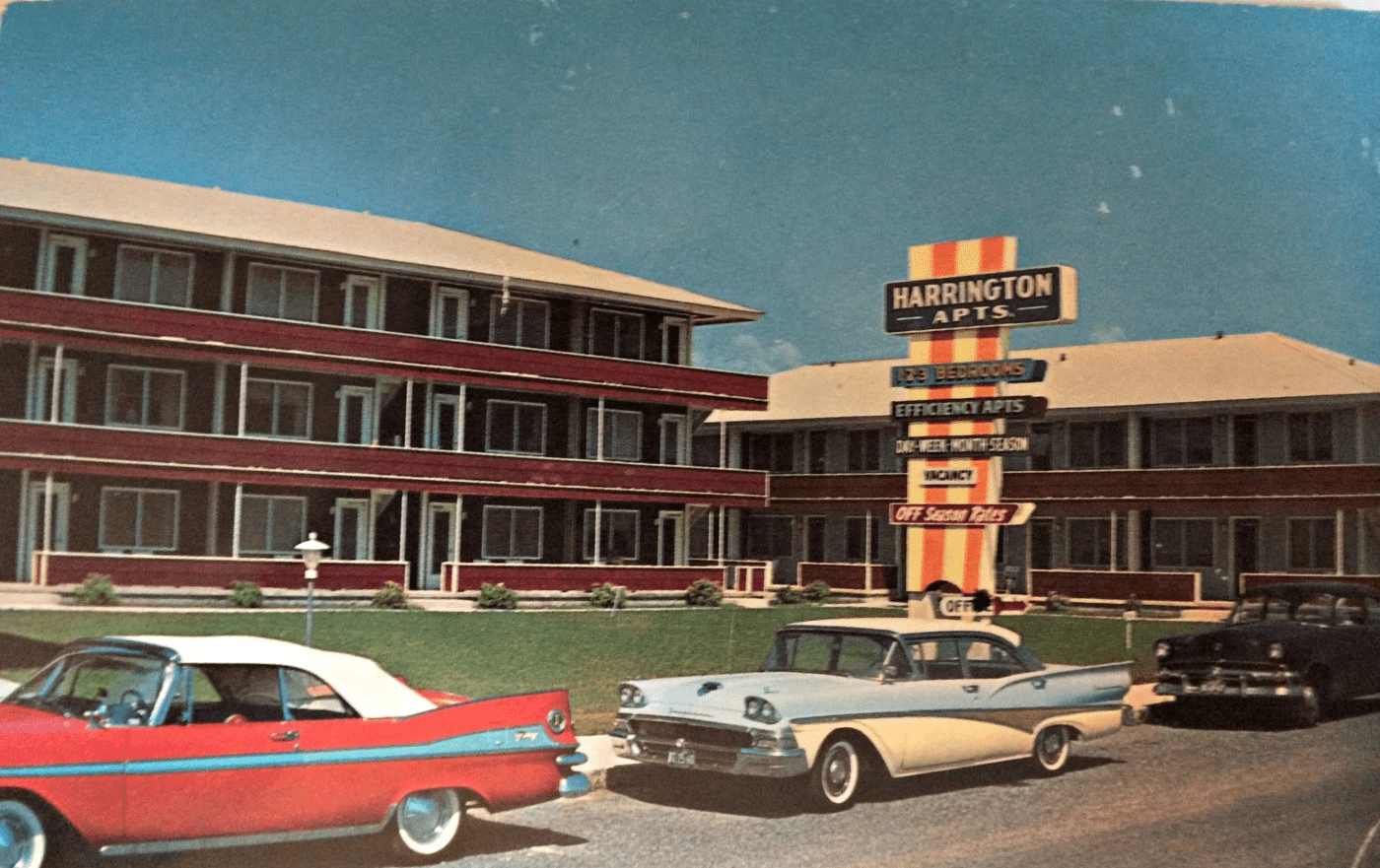
My earliest, foggiest memories of our beach trips involve staying at the Harrington Apartments on 19th Street. Mostly, I remember the building’s red exterior, and recently I was lucky enough to find an old postcard of the place.

The back of the postcard described the interiors: 

harrington description.jpg

Ads for the apartments with similar language ran in the Baltimore Sun in the mid-1950s and early 1960s to entice would-be beachgoers. And one ad, featured in the Sun in mid-April 1959, described the Harrington as “facing the ocean,” (although I can’t really remember after all these years).

The apartments were built and run by the Harrington brothers: Gordon, William and Phillip, in the 1950s. They also built the Harrington Arms on 29th Street in 1960 as well as other Ocean City motels that still are in existence today, including the Sea Hawk on 124th Street and the Shangri La on 84th Street, according to a 1989 article in the Daily Times.

Gordon Harrington shared his memories in a few articles and letters to the editor. From one 1993 Daily Times letter: “I did a lot of thinking back and reminiscing this past July 4 about my first July 4 in Ocean City — 54 years ago in 1939.

“I rented the Dinner Bell restaurant, which was in the Monticello Hotel on 3rd Street. It was a family business, which included my brothers, Gerald, Phillip and Bill,” he wrote to the paper, and shared stories of the restaurant’s beginnings, including a dog fight that occurred in the dining room during the short time they allowed pets in the restaurant!

It appears as though the Harrington of my childhood closed for good in 1989. In early October of that year, a notice appeared in the Daily Times announcing the auction date of the furnishings of the 40-unit building, including refrigerators, window air conditioners, lawn furniture, end tables, beds, kitchen utensils, curtains and more.

Then, in late November 1989, a brief appeared the Daily Times regarding the structure:

“Several traffic signals along Coastal Highway were taken down by the State Highway Administration Monday night in order to facilitate the move of 12 buildings, police said. The buildings were part of the Harrington Apartments located on Baltimore Avenue between 19th and 20th streets, police said.”

The Harrington brothers have all passed away; Gerald died in 1949, Phillip died in 1985, William died in 1991, and Gordon died in 1998, according to obituaries in the Daily Times and Star-Democrat newspapers.

In a 1989 Daily Times article, Gordon shared his thoughts about Ocean City, past, present and future: “It’s a good family place. It’s been good to me. I have a lot of good memories of this place. I want other people to have those memories.

“…I look out at the beach and see kids two years old digging in the sand. I have to believe that as they get older, they will remember all this and come back to Ocean City.”

I remember, and I bring my children back every year to experience Ocean City and to make memories just like the cherished ones I have from my childhood.

Contact us at hello@whenwebegan.com to start telling your story!

Sources: Baltimore Sun, April 19, 1959; Daily Times, November 17, 1949, October 8, 1989, October 15, 1989, November 12, 1989,  November 22, 1989, February 14, 1991, October 13, 1993, August 28, 1998; Star-Democrat, July 10, 2005 via newspapers.com

The Mystery of Stewart A. Geisbert Lunch

The piece below was originally featured on bygonemaryland.com 

Passing through the 300 block of North Market Street in downtown Frederick one spring day a while back, I finally noticed it. 

I had driven down this street countless times, always admiring the character and architecture found there. I’d even been to the Old Towne Tavern across the street many times in my 20s (many years ago), but never spotted it.  

But there it was, hidden in plain sight. Painted on an upper window of what used to be a storefront were the words “Stewart A. Geisbert Lunch.”

And with that, I started my quest to find out more.

At first, I thought it would be easy to find information, like the other times I’d researched ghost signs I’d spotted.

But this was different. No ads for Stewart A. Geisbert Lunch in the local papers. The closest I could find were ads for a Stewart A. Geisbert who was a Baltimore Sun newspaper distributor and one who was the head of a bus line. And there were other Stewart Geisberts in town in the same time period — hard to believe, but true. 

It all left me wondering: Who was Stewart A. Geisbert? The answer took a while to find, and I know I’ve only scratched the surface, but I’m excited to share what I’ve found out so far.

***

Intrigued to learn more about this mystery man, I turned to Ancestry.com to see what I could find.

A June 1917 World War I draft registration card provided some details about Stewart. At that time, he was 28 years old with gray eyes, dark hair, a medium build and of medium height. The card listed his employment as a merchant.

A few years later, in the 1920 census, Stewart’s occupation was listed as the proprietor of a bus line, and he was living as a boarder in Frederick. By 1930, he was in the East Third Street home that he lived in until his death 20 years later. The 1930 census also revealed that Stewart had married at age 30, and he and his wife Naomi had had a daughter and three sons. At this time, his occupation was listed as a chauffeur at a taxicab company. 

The 1940 census shared some changes in Stewart’s life. At this point in his life, he’d become a widower, and his occupation was listed as a daily newspaper distributor.

While I was unable to determine when he opened Stewart A. Geisbert Lunch on Market Street, according to Frederick City directories, he operated it from at least 1940 through 1942; it was listed in the directory as a restaurant and bowling alley. 

When it was time to register for the World War II draft in April 1942, Stewart was listed as self-employed, with his home address and North Market Street address listed for his employment location. By this time, according to the draft registration, his dark hair had turned gray.

An auction notice in The News in August 1943 listed Stewart’s restaurant and bowling alley merchandise up for auction, including a “luncheon counter and 12 stools … 2 sets rubber band duck pins and 15 duck pin balls…” among the many other items needed to run a restaurant.

Stewart died in 1951. From his obituary in the Baltimore Sun: “Mr. Geisbert was one of Maryland’s pioneer bus line operators. After World War I, he operated a fleet of Packard limousines between Frederick, Baltimore and Washington. He became Frederick distributor for the Sunpapers eighteen years ago.” His obituary also revealed that he had remarried.

Sadly, his 24-year-old son, Stewart A. Geisbert Jr., a brakeman for B&O Railroad, died later that year from injuries he sustained after being found along the tracks in Brunswick, though officials were unsure of the exact circumstances. 

Stewart A. Geisbert is buried in Frederick’s Mount Olivet cemetery. 

Ready to tell your story? Email hello@whenwebegan.com to get started! 

Sources:

Ancestry.com. U.S. World War I Draft Registration Cards, 1917. Registration State: Maryland; Registration County: Frederick; Roll: 1684370; Draft Board: 1

U.S. Federal Census Year: 1920; Census Place: Frederick, Frederick, Maryland; Roll: T625_672; Page: 5A; Enumeration District: 62 via Ancestry.com

U.S. Federal Census Year: 1930; Census Place: Frederick, Frederick, Maryland; Page: 4A; Enumeration District: 0005; FHL microfilm: 2340609 via Ancestry.com

U.S. Federal Census Year: 1940; Census Place: Frederick, Frederick, Maryland; Roll: m-t0627-01548; Page: 10A; Enumeration District: 11-9 via Ancestry.com

1940 Frederick, Maryland City Directory. Ancestry.com. U.S. City Directories, 1822-1995 [database on-line]. Provo, UT, USA: Ancestry.com Operations, Inc., 2011
1942 Frederick, Maryland City Directory. Ancestry.com. U.S. City Directories, 1822-1995 [database on-line]. Provo, UT, USA: Ancestry.com Operations, Inc., 2011.

Ancestry.com. U.S., World War II Draft Registration Cards, 1942 [database on-line]. Lehi, UT, USA: Ancestry.com Operations, Inc., 2010.

The News, August 14, 1943; Baltimore Sun, January 3, 1951; The News, January 3, 1951; The News, October 3, 1951